
Six days is a long time in Silicon Valley. Jensen Huang is back at Nvidia, its shares have surged, and President Trump’s intervention has demonstrated just how quickly political power can change the course of events when something is deemed strategically important. What if global health commanded the same political urgency?
Consider the contradictions of our times. Scientists are embarking on a billion-cell project, seeking to recreate human biology through artificial intelligence, with the tantalising prospect of testing medicines on virtual representations of individual patients. Yet measles, a disease we have known how to prevent for decades, is making an unwelcome comeback in the United States.
We are unravelling the genetic architecture of mental illness, while decades of pioneering research into nutrition, cancer and cardiovascular disease have become entangled in political disputes. International scientific cooperation is increasingly constrained by geopolitical boundaries that disease itself does not recognise. And, in an extraordinary inversion of healthcare’s purpose, some patients in American hospice care are losing access to services because they have lived longer than anticipated.
We are becoming remarkably precise in our understanding of human biology, yet remain remarkably imprecise in how we organise, finance and deliver healthcare.
Politics is not a spectator in any of this. Political leadership can mobilise investment, strengthen prevention, protect scientific independence and dismantle barriers to patient access. Political interference, however, can undermine the very institutions upon which medical progress depends. Knowing where to intervene — and where not to — is an increasingly important responsibility of government.
Against this backdrop, Sanofi is committing $41 billion to its respiratory business, Medicare is projecting $9.2 billion in savings through drug price negotiations, and African leaders are gathering in Addis Ababa to address fundamental questions of health financing, sovereignty and global governance.
This week’s clinical developments further illuminate the challenge. Breast cancer treatment is moving earlier in the disease pathway. A genetic diagnosis can now open the door to treatment for a form of muscular dystrophy, while another therapy has been refused approval because of compromised clinical evidence. Lilly is investing hundreds of millions in the biological promise of a Huntington’s disease treatment before its first human trial.
The science is moving. The capital is moving. Are our institutions moving with them?
From Addis Ababa to Doha, the opportunity for political intervention is clear: investing in diagnostics, aligning reimbursement with innovation, protecting regulatory integrity, strengthening international research cooperation and ensuring that geography does not determine a patient’s access to medical progress.
The next breakthrough may emerge from a laboratory, an AI model or a billion-dollar acquisition. But whether it reaches the patient will depend as much on political choices as on scientific ingenuity.
Jensen is back. Political intervention has shown what it can achieve when the stakes are considered high enough.
Surely, human health qualifies.
The bill for the next breakthrough may be substantial. The bill for failing to deliver it could be considerably higher.
This week
- Sanofi’s $41 billion respiratory bet— a major acquisition puts established patients and future pipeline growth in the same deal.
- Medicare sets new prices for 13 drugs— a significant purchasing decision whose latest prices take effect in 2028.
- Africa takes the global health argument to Addis Ababa— financing, manufacturing and a voice in WHO leadership move onto one political stage.
- Breast cancer treatment moves earlier— a new post-surgery option brings a measurable benefit and a fresh access decision.
- A genetic diagnosis opens a treatment pathway— the first approved therapy for limb-girdle muscular dystrophy.
- The FDA refuses a Duchenne cell therapy— patient urgency meets a hard finding on trial-data integrity.
- Lilly buys into Huntington’s disease— a $725 million deal for a mechanism still awaiting human testing.
- A cancer survival win comes with an important miss— Merck’s TROP2 drug meets one endpoint and misses another.
- Europe plans for the next health emergency— five roadmaps put diagnostics alongside vaccines and medicines.
| This is not another health news digest. It’s a twice-weekly readout of where evidence meets power and where power must turn into action. |
Sanofi is buying its next decade for $41 billion
Sanofi announced an agreement on Tuesday to acquire Insmed for $41.0 billion in cash, or $175 per share. The proposed purchase brings two marketed respiratory medicines—Brinsupri for non-cystic fibrosis bronchiectasis and Arikayce for certain patients with Mycobacterium avium complex lung disease—alongside a phase III programme for inhaled treprostinil palmitil. The deal remains subject to shareholder and regulatory approvals, with closing expected in the first half of 2027. Sanofi’s announcement.
This is a bet on more than a molecule. Sanofi is paying for medicines that already have defined clinical uses, the ability to reach more patients, and a pipeline that could extend its respiratory business. The test after any deal of this size is whether broader commercial reach also improves diagnosis, specialist referral and access. Those steps determine how many eligible patients can benefit; the acquisition itself cannot settle them.
Washington has set new drug prices. Patients will wait until 2028
On Monday, the US Centers for Medicare & Medicaid Services announced negotiated prices for 13 high-cost medicines used across cancer, inflammatory disease and other conditions. CMS estimates $9.2 billion in net savings, or 45%, across the selected drugs. The new prices take effect on 1 January 2028. This round also brings medicines paid for under Medicare Part B—often administered in a clinical setting—into the negotiation programme. CMS’s announcement.
This is a substantial shift in purchasing power, but the headline savings figure is not a promise of the same reduction in every patient’s bill. Its effect will depend on the medicine, coverage and how the prices are implemented. Placed beside Sanofi’s acquisition, the decision captures the pressure shaping the industry: companies are paying heavily to secure future products while public purchasers are becoming more assertive about what they will pay for established ones.
Addis Ababa is asking who gets to govern global health
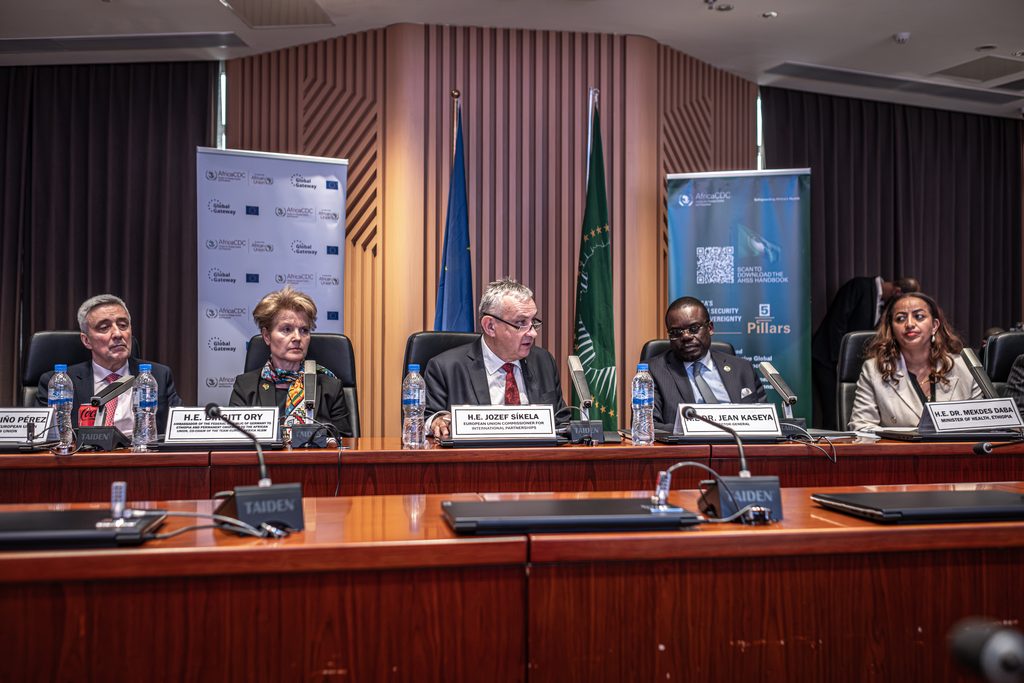
The Conference on Public Health in Africa opened in Addis Ababa on Monday with political discussions on financing and African ownership of health systems. Its programme included a dialogue between African ministers and candidates for WHO Director-General. Discussions scheduled for Tuesday turn to the global health architecture, immunisation, local manufacturing and a proposed health financing pathway. Africa CDC’s programme | conference advisory
The political force of the meeting lies in putting representation beside delivery. Africa CDC is pressing for stronger regional manufacturing, procurement, surveillance and financing as external funding becomes less certain. For patients, sovereignty becomes meaningful when it shortens the distance to a reliable test, a vaccine or treatment. The conference gives leaders a platform; the measure of success will be the institutions and budgets that follow.
Breast cancer treatment has moved into the years after surgery
The FDA approved giredestrant (Wilserdly) on Monday as a treatment used alone after surgery for adults with ER-positive, HER2-negative stage I–III breast cancer at intermediate to high risk of recurrence. In the 4,170-personlidERA trial, 92.4% of patients taking giredestrant were alive and free of invasive breast cancer at three years, compared with 89.6% receiving standard hormone therapy. Patients are still being followed to establish whether the treatment helps them live longer. The FDA’s approval announcement.
This is a consequential move into earlier disease, where treatment may continue for years and the benefit must be weighed carefully for each patient. The three-year difference is 2.8 percentage points: meaningful, but more informative than a relative-risk figure alone. The indication also differs from giredestrant’s approval last week for ESR1-mutated advanced disease. This post-surgery approval does not require an ESR1 mutation. Clinicians and payers will need to keep those two treatment pathways clear as they decide who should receive the medicine.
For one muscular dystrophy, the genetic diagnosis now leads to a medicine
The FDA approved ribitol (Welgemda) on Monday for people with limb-girdle muscular dystrophy type 2I/R9 who weigh at least 30 kg. It is the first approved medicine for any form of limb-girdle muscular dystrophy. The condition is linked to FKRP mutations; in a placebo-controlled study of 112 genetically confirmed patients, the FDA reported improvements in walking speed and lung function at a planned 12-month analysis. The FDA’s approval announcement
For families who have spent years seeking a diagnosis, this changes what that diagnosis can lead to. It also makes access to genetic testing part of access to treatment: patients cannot enter a genotype-defined pathway if they are never identified. The next practical questions are how quickly people can be diagnosed, referred and assessed for treatment, and how health systems will follow outcomes beyond the trial.
The FDA has drawn a hard line on Duchenne trial data
On Friday, the FDA issued a complete response letter refusing to approve Capricor’s cell therapy deramiocel for Duchenne muscular dystrophy. The agency said its inspection found serious problems in the HOPE-3 trial, including unauthorised changes to the statistical analysis plan after the fact, breaches of blinding procedures and other protocol violations. The trial had also failed its prespecified primary and secondary efficacy endpoints. In the FDA’s assessment, the underlying data could not reliably support approval or be repaired through later analysis. The FDA’s statement.
The decision is painful for a community facing a progressive disease and few options. It also marks a limit to regulatory flexibility: patients’ need can justify urgency and thoughtful trial design, but it cannot make compromised data interpretable. Developers working in rare diseases should take this as a demand to protect trial conduct from the start. Families should be able to trust that an approval rests on evidence capable of answering the question they most need answered.
Lilly has bought a Huntington’s theory before its first human test
Lilly has acquired UK-based LoQus23 Therapeutics in a deal worth up to $725 million, including payments tied to development and regulatory milestones. Its lead candidate, LQT-23, is an oral drug designed to inhibit MSH3, a protein involved in the expansion of repeated DNA sequences associated with Huntington’s disease progression. The candidate has shown activity in cellular and animal models; a clinical trial application is anticipated, but human efficacy has not been established. LoQus23’s announcement
The deal shows how much value industry places on a strong biological explanation of disease, even before a patient has received the treatment. For Huntington’s families, the distinction matters: an acquisition can accelerate development, but it does not establish that slowing DNA-repeat expansion will preserve function. The next decisive steps are well-designed human studies and measures that connect the proposed mechanism to outcomes patients can feel.
Merck’s cancer drug passed the survival test, then missed another
Merck reported on Friday that its investigational TROP2-directed antibody–drug conjugate, sacituzumab tirumotecan, improved overall survival against the physician’s choice of treatment in a phase III trial involving 473 patients with advanced gastroesophageal adenocarcinoma who had received at least two prior lines of therapy. The study did not meet its secondary progression-free-survival endpoint. Merck has not yet released the full numerical survival results; it plans to present the data at a medical meeting and discuss them with regulators. Merck’s trial announcement
For patients with few remaining options, living longer is an important result. The missed endpoint means the full data matter: clinicians will want to understand how large the survival gain was, its harms, and whether particular groups benefited more. Merck said the result was generally consistent across groups regardless of TROP2 expression, raising a further question for personalised oncology: whether measuring the target will help select patients for this treatment, or whether other markers of benefit are needed.
Europe is trying to buy time before the next emergency

The European Commission published five medical countermeasure roadmaps on Monday, covering pandemic influenza, Ebola and related viruses, dengue, drug-resistant bacteria and nerve agents as models for wider threat groups. The plans identify potential gaps in diagnostic tests, vaccines, treatments and protective equipment, and look across development, production, procurement, stockpiling and deployment. The Commission’s announcement
The useful shift is to treat the test as part of the response from the outset. A stockpile cannot be deployed precisely if clinicians cannot identify the threat quickly and laboratories lack the capacity to confirm it. These roadmaps are plans, not supplies already in place. Their value will depend on whether governments turn identified gaps into purchasing decisions, viable production capacity and distribution routes that work during a crisis.
The November watch
| 25–27 November | Addis Ababa: |
| The remainder of CPHIA 2026, including discussions on local manufacturing, digital health and the financing commitments behind African health sovereignty. Africa CDC |
| 29 November, 13:50–14:50 | Doha: |
| Earlier Cancer Diagnosis for Longer Healthy Lives at WISH, in Room 103, will bring the discussion back to the pathway from detection to care. WISH |
| 29–30 November | Doha: |
| WISH 2026 will bring policymakers and practitioners together on health financing, innovation and delivery. Qatar Foundation |
Follow the last-mile conversation!
IPM Alliance tracks the decisions, bottlenecks and implementation gaps shaping personalised medicine access. Follow us for briefings, events, policy signals and practical insights from across regions and disease areas.
We want to hear from you
When a patient becomes eligible for personalised care, where does the system most often lose them: identification, testing, referral, reimbursement, delivery capacity or equity?
Know someone who should be reading this?
IPM Brief is built for people working where science, policy and patient access collide. If one colleague would find this useful, forward it to them and help bring them into the conversation.
International Alliance for Personalised Medicine
Avenue de l’Armée / Legerlaan 10, 1041 Brussels, Belgium
