
Dear friends,
We are living through a curious period of political change, political continuity and, occasionally, change that looks remarkably like continuity. Before elections, almost everything appears possible. Healthcare will improve, science will flourish, innovation will accelerate, inequalities will narrow and public services will be strengthened. All this, naturally, while maintaining responsible public finances. There is something wonderfully contradictory about promising to do everything for everyone, while knowing that governing will eventually require choosing between them.
Then comes the rather more banal business of government. Budgets must be agreed, priorities reconsidered and promises reconciled with economic reality. What was indispensable before polling day may become unaffordable afterwards. And what was barely mentioned during the campaign can suddenly command billions.
In politics, change is often measured by who wins an election. In healthcare, it is measured by what governments are prepared to finance.
Brazil has just voted, Israel’s elections are upon us, and the United States faces its midterms in November. Across Europe and other regions, further electoral cycles will bring changing governments, renewed mandates and competing priorities. Yet beneath these political contests lies a question that will determine the future of healthcare, research and innovation.
Where will the money go?
Towards defence, competitiveness, energy security, infrastructure or healthcare? And within healthcare, towards immediate service pressures, prevention, diagnostics, research, innovative treatments or the people and infrastructure needed to deliver them? Europe’s negotiations over its next long-term budget for 2028–2034 make these choices particularly immediate. Scientific ambition is one thing. Financing its translation into routine healthcare is quite another. The ancient Ship of Theseus offers an interesting parallel. We replace governments, ministers, strategies and regulations, one plank at a time. Eventually, almost everything appears to have changed. Yet we are left wondering whether we have created something fundamentally different or simply reconstructed the same vessel.
And that brings us to Claudia.
Claudia has been told she has cancer. Her next question is immediate: what happens now? She does not know which electoral promises have survived the latest spending review, whether molecular diagnostics are reimbursed or whether investment in innovative medicines has been matched by investment in the services required to deliver them.
Nor should she have to. Yet her next steps depend on precisely those decisions: which tests are available, where specialist expertise exists and whether a promising result opens a realistic route to treatment. At IAPM’s personalised oncology implementation meeting, held alongside ESMO in Madrid on 23 October, Claudia’s journey provided a human measure of these institutional choices.
John Longshore described how clinical value disappears between ordering a biomarker test and using its result. Ernest Nadal showed how hospital organisation delays decisions even when technology is available. Patient representatives explained how institutional gaps become their responsibility to navigate. Mark Schmid emphasised that diagnostic services must be prepared alongside the development of innovative medicines.
These are not simply technical failures. They reflect political decisions about financing, priorities and responsibility. A government can reimburse a medicine without funding its diagnostic. A hospital can purchase equipment without financing the workforce required to use it. Europe can invest in collaborative research while patients struggle to reach the expertise or clinical trials that research has helped create. The technology exists. The research has succeeded. The political commitment may even have been fulfilled.
And still Claudia waits.
This is why IAPM’s proposed Public–Private Implementation Compact and Innovation & Access Fund matter. They must address the gaps between scientific progress and actual delivery, with clear responsibilities, measurable outcomes and sustained financing. Crucially, they must survive electoral cycles. A diagnostic network cannot be rebuilt every time a government changes, nor can access to innovation depend on the enthusiasm of a single minister.
Madrid supplied the questions that should govern this work. Who orders the test? Who checks the result? Who explains the options? Who pays for the next step? And who intervenes when the pathway stops? Elections will come and go. Governments will change, or remain. Budgets will expand, contract and be redirected. The Ship of Theseus will continue to acquire new planks. But Claudia cannot wait for another political promise.
Ultimately, the measure of political change is not how often we rebuild the ship, but whether it takes the patient where she needs to go.
Claudia should not have to assemble those answers herself.
In this issue
- The clock starts before the treatment: The first days after diagnosis need a clear plan and someone responsible for moving it forward.
- An early signal needs somewhere to go: Earlier detection helps Claudia only when the health system can complete the follow-up.
- Where the value disappears: A biomarker test must be ordered, returned in time and used in the treatment decision.
- The postcode enters the laboratory: Testing access depends on local capacity, quality, financing and clinical expertise.
- Claudia has become the coordinator: Patients are left to manage gaps in information and handovers that services should handle.
- Someone has to own the handover: Diagnostic teams, specialists and partners need clear responsibilities across the pathway.
- A scanner cannot organise a service: Digital pathology and molecular testing require quality assurance, staff and sustained infrastructure.
- Eligible on paper and waiting in practice: A molecular finding must lead to a realistic treatment, trial or referral option.
- The pathway that must precede the medicine: Diagnostic capacity and reimbursement need planning while new treatments are developed.
- Fund the work between the breakthroughs: A possible Innovation & Access Fund could support the capacity that takes successful pilots into routine care.
- Research has to reach Claudia before the project ends: iBeChange, BRECISE and SYNTHIA connect prevention, biomarker validation and data research to future care.
- The pathway must include the person living through it: SPARC and ON-COME bring implementation and continuing support into the patient journey.
- Give Claudia a name to call: The proposed Compact needs measurable guarantees and people accountable for delivering them.
| This is a special edition of IPM Brief, reporting from IPM Alliance’s New York discussions on 23 and 24 September 2026. |
The clock starts before the treatment
The opening discussion placed time at the centre of personalised oncology. Núria Malats and José Martín-Moreno framed the first days after suspicion or diagnosis as a period in which patients need support, coordinated investigation and a route to a treatment decision. The programme’s checkpoints of 24 hours, seven days and one month gave the conversation something tangible to test: who makes contact, who brings the diagnostic information together, and who ensures that a plan follows? These were proposed expectations for discussion, with the appropriate response depending on the cancer and clinical circumstances.
Denis Horgan connected that sequence to the decisions governing healthcare delivery. The people who understand diagnosis and treatment need to help shape the policies under which both operate. For Claudia, the practical requirement is someone who can see beyond an individual appointment and coordinate the next steps. For hospital leaders and public authorities, it means measuring the intervals between suspicion, diagnostic resolution and an appropriate intervention. A department may meet its activity targets while a patient spends weeks waiting between services. Those weeks belong in the assessment of performance.
An early signal needs somewhere to go
Malats brought an essential distinction to the early-detection debate. Screening an asymptomatic population, monitoring people at elevated inherited or familial risk, and investigating symptoms are different pathways. Her pancreatic-cancer perspective showed why those distinctions matter. The population being tested changes how a result should be interpreted, which professionals need to respond and what follow-up should be organised. A test needs a defined purpose, an identified population and a clinical question before its place in care can be judged.
For Claudia, an earlier finding creates an opportunity only if the system can act on it. Malats connected that opportunity to clear eligibility, diagnostic resolution, responsibility for follow-up and adequate resources. This gives early-detection policy an obligation beyond purchasing tests. Imaging, specialist assessment and the explanation of uncertain findings all require capacity. A government supporting a new detection approach should be able to describe the route that follows a concerning result and show how patients complete it. Otherwise, the system brings forward the moment of uncertainty without securing the benefit of earlier action.
Where the value disappears
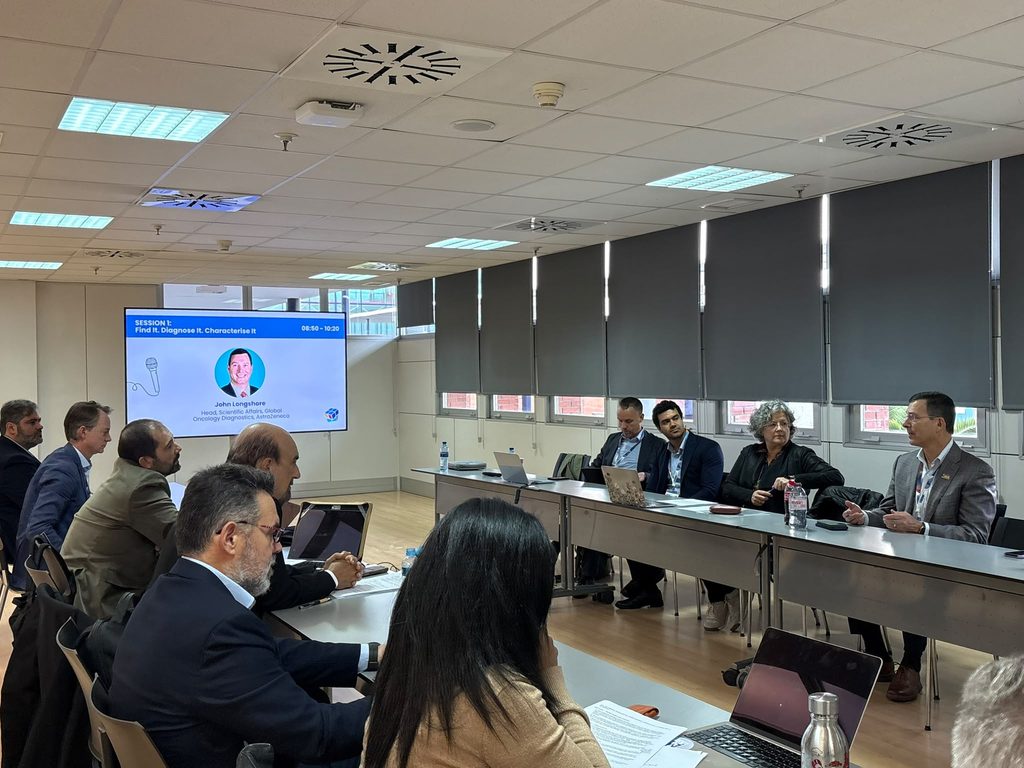
John Longshore of AstraZeneca described biomarker testing as a continuous process. Selecting the appropriate test matters, but uncertainty about selection must not become a reason for failing to order one. The laboratory then has to return a reliable result while it can still inform the treatment decision. A further failure can occur after both those steps have succeeded: the result is already in the medical record, yet it is overlooked or does not influence care. His contribution located the loss of value across the whole sequence, from the first order to the clinical action. A technically successful test can still fail the patient.
Longshore’s practical proposal was appropriately defined reflex testing: an agreed histological diagnosis automatically triggers the relevant biomarker investigations, removing the need to wait for another individual order. That approach still requires a laboratory capable of delivering timely results and a clinical team ready to use them. For Claudia, the guarantee should therefore extend beyond whether a test was performed. Was the necessary information available when her treatment was chosen? Was it reviewed, explained and incorporated into the decision? Hospitals and payers should measure that sequence together. Longshore’s argument challenges a familiar division of responsibility in which the laboratory reports completion, the clinical service makes a decision and nobody examines whether the two events were properly connected.
The postcode enters the laboratory
Nicola Normanno widened the discussion from the availability of next-generation sequencing to the conditions under which patients can benefit from it. Laboratory infrastructure, trained professionals, quality assurance, referral arrangements and sustainable financing all influence whether a usable result reaches the clinician. His implementation perspective also challenged the assumption that a solution designed for a major centre can simply be transferred elsewhere. Local capacity and needs have to shape the starting point, including in settings where more basic diagnostic gaps remain unresolved.
Luiz Correa of Natera connected these inequalities to financing and education. Medicine and diagnostic expenditure can sit in different budgets, leaving the value of testing disconnected from the decisions that fund it. Knowledge and confidence also vary between specialist and smaller centres. The policy consequence is that access cannot be assessed through a national declaration that testing is available. It needs to be examined where Claudia actually receives care. Can her hospital order the appropriate investigation, obtain a dependable result and understand what to do next? A national network should make those capabilities reachable across its territory, with support for the centres and professionals expected to deliver them.
Claudia has become the coordinator
Ingrid Krücken of Europa Donna Luxembourg challenged the assumption that information reaches patients simply because a test has been performed. Patients may not understand what was ordered, why it matters or what happens while they wait. She described how patient organisations can translate complex information and collaborate with hospitals, while stressing that patients should not need a medical education to participate in care. The discussion also brought primary care into view: the professional who knows the patient’s wider history may be poorly connected to developments in specialist oncology.
George Kapetanakis of ELLOK showed how an announced policy can encounter operational barriers before patients experience its benefit. His account of biomarker access in Greece brought the discussion back to implementation: payment arrangements, institutional processes and practical responsibilities must work after a decision has been made. Patients experience these gaps across the entire journey and should help define the measures used to judge a network. For Claudia, participation means a comprehensible plan, someone to contact and a service that tracks its own handovers. Patient organisations need resources and expertise to contribute to that design. Their involvement should reduce the coordination work carried by patients.
Someone has to own the handover
Ernest Nadal located a major lung-cancer bottleneck inside hospital organisation. A patient can reach the oncologist before the information needed for a decision has arrived, even where testing exists. He called for closer connections between diagnostic and treatment teams, stronger links between molecular and disease-specific tumour boards, and a coordinator with protected time. Jesús García-Foncillas extended that argument to national networks. Specialist interpretation should help patients reach a treatment or trial, supported by common standards, evaluation and sustainable financing. Responsibility has to continue beyond the tumour board’s recommendation.
Benjamin Gannon of Guardant Health showed why those responsibilities cross institutional boundaries. Bringing liquid-biopsy capability into a hospital involves sample preparation, sequencing, bioinformatics, validation, sufficient activity and planning for technological change. Local provision, central testing and network arrangements require different capabilities. Health-system leadership must decide how those functions are organised and how other hospitals reach them. For Claudia, the resulting agreement should establish who receives the sample, who interprets the result, who contacts her treating team and who checks that the next action occurred. The value of a partnership becomes visible in the reliability of those handovers.
A scanner cannot organise a service
Paul Hofman brought digital pathology back to everyday diagnostic work. Digital images can support specialist review, training and potentially faster reporting, but their usefulness depends on specimen preparation, scanning quality and validation. The discussion distinguished owning a scanner from operating a sustainable digital service. Storage, technical staff and an institutional strategy remain necessary. Hofman also explored how assessing the adequacy of a small tissue sample could prompt an additional diagnostic approach sooner, preventing an insufficient sample from producing another round of delay.
Albrecht Stenzinger exposed a related vulnerability in molecular testing. Laboratories need to understand the limits of their assays and bioinformatics pipelines. Failure to identify an alteration may reflect the method or interpretation rather than the absence of a relevant tumour feature. Those distinctions can change a patient’s options. Procurement and reimbursement should therefore account for validation, quality assurance, interpretation and continued operation alongside the equipment. For Claudia, diagnostic access includes confidence that the result is fit for its purpose, its limitations are visible and an inconclusive finding leads to an appropriate response.
Eligible on paper and waiting in practice
Alfredo Carrato’s pancreatic-cancer contribution placed accurate diagnosis and timely specialist care at the beginning of a credible precision-medicine pathway. Adequate diagnostic material, multidisciplinary expertise and access to trials were connected to nutritional, psychological and physical support. Specialist referral also needs a route back to local services where appropriate. Vivek Subbiah sharpened the access question by proposing the interval from biopsy to the first dose of an appropriate matched therapy as an important measure of pathway performance. It makes the practical consequences of a molecular finding visible, alongside assessment of appropriateness and outcomes.
Live Fagereng described how collaboration between national precision-oncology trials can connect molecular findings, evidence generation and implementation. PRIME-ROSE’s documented programme addresses uneven diagnostics, expertise, reimbursement and trial access. PRIME-ROSE project reporting. The difficult question is what happens when the relevant option is elsewhere or outside routine funding. Subbiah proposed conditional access with defined responsibilities, evidence collection and reassessment. Such arrangements require careful design around clinical evidence and uncertainty. For Claudia, a credible pathway needs an honest account of the options, a practical route where one exists, and timely communication when it does not.
The pathway that must precede the medicine
Mark Schmid of MSD brought the discussion upstream, into the development of a biomarker-driven medicine. How early should planning begin for the diagnostic, reporting process and referral arrangements? His answer recognised an important constraint: the science does not always reveal the diagnostic requirement at the same point. Some needs are apparent early; others emerge as a hypothesis is tested. The implementation challenge also varies. Adding a familiar biomarker to an established service is different from asking a health system to introduce a new platform, acquire expertise or create a reimbursement route. The more substantial the change, the more preparation is required. Hospitals and payers need information early enough to plan, while development uncertainty and commercial confidentiality can complicate that exchange.
His discussion with Stenzinger exposed another gap: an assay that works for selecting patients in a controlled clinical trial may not fit the diagnostic workflow used in routine care. Hospitals cannot operate a separate platform and process for every medicine. Yet using a different local method requires confidence that it identifies the patients the evidence concerns. That bridge has to be built deliberately. Schmid also separated different layers of access: whether the test is available, whether an institution can perform it and whether its use is funded. These distinctions matter for any proposed Innovation & Access Fund. An investment may need to establish infrastructure before routine reimbursement can deliver its intended benefit. For Claudia, the implication is immediate: diagnostic readiness belongs inside the planning for a medicine’s introduction, with an agreed transition from initial support to a sustainable health service.
Fund the work between the breakthroughs
The strongest case made for a possible Innovation & Access Fund concerned work that ordinary funding arrangements can leave exposed. Ebba Hallersjö Hult, drawing on Swedish collaboration around Vision Zero Cancer and subsequent initiatives, emphasised the capabilities needed to move from a successful pilot into routine care. These include coordination, workforce, shared protocols, patient navigation, implementation leadership and evaluation. Schmid’s account of infrastructure and financing, Fagereng’s experience of clinical networks and Subbiah’s conditional-access proposal approached the same problem from different directions: the capacity to use innovation needs investment and assigned responsibility.
The discussion supplied a rationale for developing the instrument while leaving its design open. Any fund should identify the gap it will address, the patients it should reach and the responsibilities accepted by public and private partners. Initial support should come with a credible route into continued delivery. Evaluation needs to extend beyond the best-equipped centres and examine whether patients reach appropriate decisions and care sooner. Conditional access would require explicit agreement on uncertainty, outcomes and reassessment. Public-interest governance and transparency over contributions should be part of the design. Claudia needs evidence that the investment changed the practical difficulty of obtaining care.
Research has to reach Claudia before the project ends
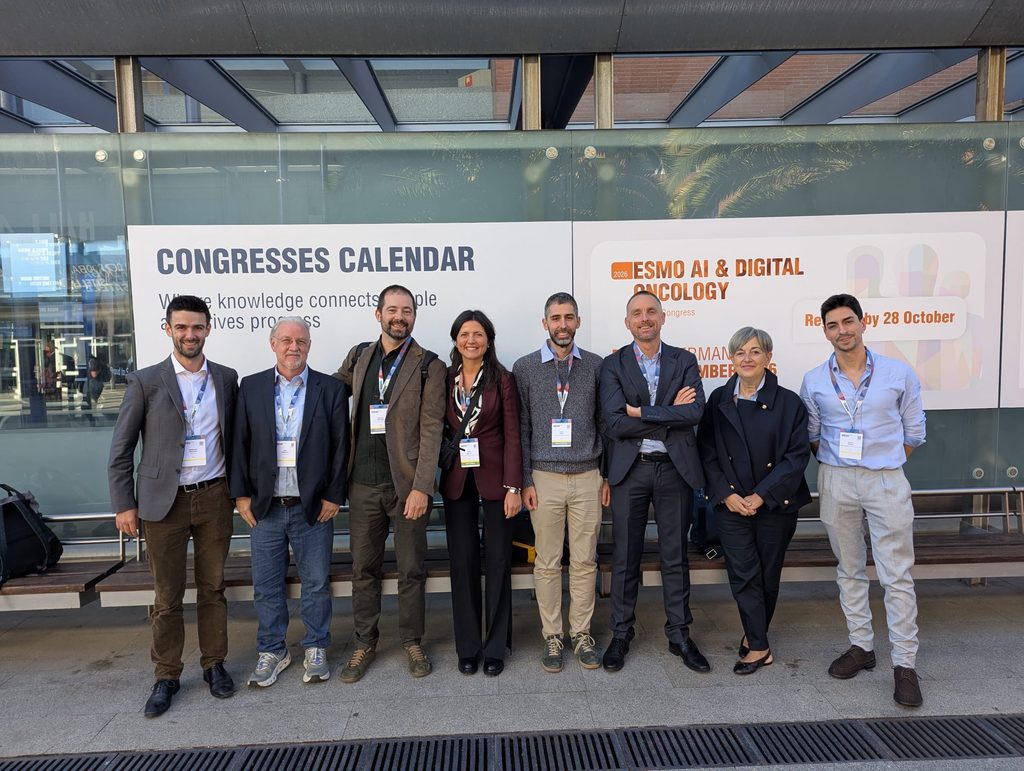
The European project perspectives connect several points at which Claudia’s future options are shaped. David Suñol Moreno’s iBeChange work at Eurecat concerns primary prevention, combining behavioural science and clinical psychology with adaptive digital technologies. Ralf Hoffmann’s BRECISE work at Philips addresses a later decision: how candidate biomarkers in prostate and bladder cancer can move through clinical validation towards useful applications. SYNTHIA, involving Adrian Galiana Bordera through IIS La Fe, tackles the data methods supporting research and AI development, including assessment of synthetic-data quality, privacy, usefulness and bias. Together, these initiatives connect prevention, evidence generation and the reliability of future clinical decisions. iBeChange · BRECISE · SYNTHIA.
Their shared implementation test is whether the work produces something a service can use responsibly. A prevention tool needs evidence that it supports meaningful change and reaches people beyond those already comfortable with digital health. A biomarker needs reproducible performance and evidence relevant to a specified clinical decision. Synthetic data need to be assessed for the intended application, including what they may conceal about real patients. Public investment should support that transition into use, with clinical teams, patients and future purchasers involved while the work develops. For Claudia, the eventual benefit depends on those decisions being made before the final project report is written.
The pathway must include the person living through it
SPARC and ON-COME bring the discussion into the organisation of services. Manuel Ottaviano’s SPARC work at Universidad Politécnica de Madrid concerns the adoption of personalised cancer medicine through approaches including next-generation sequencing, liquid biopsy and molecular tumour boards, supported by pilots, protocols, training and patient engagement. Elisa Marconi’s clinical-psychology perspective through ON-COME extends the question to psychosocial, neuropsychological and nutritional support for children, adolescents and young adults with cancer and their families. These projects address different populations and needs, while directing attention to the professionals and arrangements required to make care dependable. SPARC · ON-COME.
Their relevance to the implementation agenda lies in continuity. A molecular recommendation requires interpretation, referral and clinical follow-through. A psychological or nutritional need requires assessment, an available professional and responsibility for continued support when the patient changes setting. In both cases, training and a pilot need a future service owner and a sustainable budget. Claudia’s journey keeps these questions connected: the system must help her reach an appropriate treatment decision and support her through its consequences. Patient-pathway guarantees should make both responsibilities visible.
Give Claudia a name to call
The programme’s proposed next steps were to publish an Implementation Compact, define patient-pathway guarantees and develop the IAPM Personalised Oncology Implementation Agenda. The discussions provide substance for that work. Longshore identified how clinical value is lost between ordering a test and acting on its result. Patient representatives showed who carries the burden when coordination fails. Clinical and laboratory perspectives established the expertise and quality behind a dependable decision. Schmid demonstrated why preparation must begin while diagnostic and therapeutic strategies are still developing.
The next political commitment should be specific. Each participating pathway should identify who coordinates care, set clinically appropriate expectations for its key steps and record what happens when patients cannot reach them. Public and private partners should state which responsibilities they accept and how delivery will be reviewed with patients. Measures should include timely diagnostic resolution, use of results in decisions, access to appropriate treatment or trials, and the costs and support needs patients carry themselves. That would give the Compact a practical purpose and any future fund a way to demonstrate its value.
When Claudia asks what happens next, she should receive a plan, a time frame and the name of someone responsible for helping her move forward.
Follow the last-mile conversation!
IPM Alliance tracks the decisions, bottlenecks and implementation gaps shaping personalised medicine access. Follow us for briefings, events, policy signals and practical insights from across regions and disease areas.
We want to hear from you
When a patient becomes eligible for personalised care, where does the system most often lose them: identification, testing, referral, reimbursement, delivery capacity or equity?
Know someone who should be reading this?
IPM Brief is built for people working where science, policy and patient access collide. If one colleague would find this useful, forward it to them and help bring them into the conversation.
International Alliance for Personalised Medicine
Avenue de l’Armée / Legerlaan 10, 1041 Brussels, Belgium
