
IPM Take
Cardiovascular prevention is built around things clinicians know how to measure: blood pressure, cholesterol, smoking, diabetes and body weight.
This study asks whether another exposure belongs somewhere on that map.
Among more than 11,000 UK Biobank participants with personal light measurements and later cardiac MRI, greater nighttime light exposure was associated with increased left ventricular mass and wall thickness, poorer myocardial deformation and changes in right ventricular and left atrial structure. In a larger analysis of more than 73,000 participants, high nighttime light exposure was also associated with higher subsequent risks of heart failure, atrial fibrillation, myocardial infarction, stroke and cardiovascular mortality.
But association is not causation. Light exposure was measured for only seven days, the study was observational, and shorter sleep statistically explained part, but not all, of the associations. The cohort was also overwhelmingly White, and shift workers were excluded from the primary analysis.
The politically interesting question is therefore not whether doctors should start prescribing blackout curtains tomorrow.
It is whether cardiovascular policy has been too narrowly focused on individual behaviour while underestimating environmental exposures that patients may have limited power to control.
Executive Summary
Researchers analysed data from 11,071 cardiovascular disease-free UK Biobank participants who wore wrist devices containing light sensors for seven consecutive days between 2013 and 2015 and subsequently underwent cardiac MRI roughly three years later. Nighttime was defined individually using each participant’s least active five-hour period, rather than imposing one fixed clock window.
Compared with participants with no nighttime exposure above 3 lux, those with high exposure had 2.4% greater indexed left ventricular mass, 1.5% greater mean wall thickness and 1.9% lower myocardial contraction fraction. They also showed poorer left ventricular strain and adverse changes in right ventricular and left atrial structure and function. The associations followed broadly linear dose-response patterns.
In a separate outcomes analysis involving 73,286 participants, high nighttime light exposure was associated with a 29% higher risk of heart failure, 15% higher risk of atrial fibrillation, 24% higher risk of myocardial infarction, 33% higher risk of stroke and 26% higher risk of cardiovascular mortality during approximately eight to ten years of follow-up. These are relative associations, not proof that nighttime light caused the events.
Shorter sleep duration statistically mediated approximately 24% to 49% of many of the observed associations, suggesting that sleep disruption may be one pathway connecting nighttime light with cardiovascular health. Daytime bright-light exposure was not similarly associated with cardiovascular outcomes.
Why it matters
- HTA bodies: The study does not support assessment of a new medical technology, but it highlights a broader methodological issue. Cardiovascular outcomes may be influenced by environmental and behavioural exposures that are rarely incorporated into conventional risk models or evaluations of preventive interventions.
- Payers: If circadian disruption and nighttime light eventually prove to be modifiable contributors to cardiovascular disease, prevention could extend beyond medicines and clinic visits. However, current evidence is observational and does not yet establish that reducing nighttime light lowers cardiovascular events or healthcare costs.
- Industry / innovation partners: Wearables capable of measuring personal light exposure, sleep timing and physiological responses could enable more precise studies of the cardiovascular exposome. The commercial opportunity will depend on demonstrating that measuring these exposures changes risk prediction or patient outcomes, not simply generating another stream of biometric data.
A bedroom light seems far removed from heart failure.
But cardiovascular medicine is increasingly being forced to confront exposures that sit outside the traditional clinic, from air pollution and noise to heat, sleep disruption and circadian rhythm.
Artificial light at night may now belong in that conversation.
The new European Heart Journal study used objective light measurements rather than asking participants to remember how bright their bedrooms were. More than 11,000 UK Biobank participants wore accelerometers equipped with light sensors for seven days, after which researchers examined heart structure and function using cardiovascular MRI several years later.
The pattern was consistent across several cardiac measures.
Participants exposed to more light during their normal sleeping period tended to have thicker left ventricular walls, greater ventricular mass, poorer myocardial deformation and subtle abnormalities involving the right ventricle and left atrium. None of these changes means that an individual participant had clinical heart disease, but they are phenotypes associated with adverse cardiovascular remodelling.
The outcome analysis then pushed the observation beyond imaging.
Over approximately a decade, participants with the greatest nighttime light exposure experienced higher rates of several cardiovascular outcomes, including heart failure and stroke. The associations persisted after adjustment for multiple sociodemographic, behavioural, health and environmental factors.
The strongest finding may be the pathway, not the risk ratio
The biological argument is plausible.
Light is one of the body’s dominant signals for setting circadian rhythms. Exposure at biologically inappropriate times can suppress melatonin and influence sleep, autonomic regulation, blood pressure, metabolism and inflammatory pathways. The accompanying European Heart Journal editorial argues that nighttime light should increasingly be considered part of the cardiovascular exposome, alongside noise, air pollution and other environmental stressors.
The study’s mediation analysis supports sleep as one part of that pathway. Shorter sleep duration statistically accounted for between 24% and 49% of many associations between nighttime light and cardiac changes.
But “mediated” does not mean “proved.”
Observational mediation analyses cannot establish a causal chain from light exposure to poor sleep to cardiac remodelling. Other unmeasured factors could influence both the sleep environment and cardiovascular health.
That distinction matters because the numbers are tempting to translate immediately into lifestyle advice.
A 33% higher relative risk of stroke sounds dramatic. But the study does not tell us that switching off a bedside light will reduce an individual’s stroke risk by 33%.
It tells us that nighttime light exposure identifies people who, in this cohort, subsequently experienced more cardiovascular disease.
Those are very different claims.
Is darkness an individual responsibility or a public-health issue?
The study becomes more politically interesting when nighttime light is treated as an environmental exposure rather than simply a personal choice.
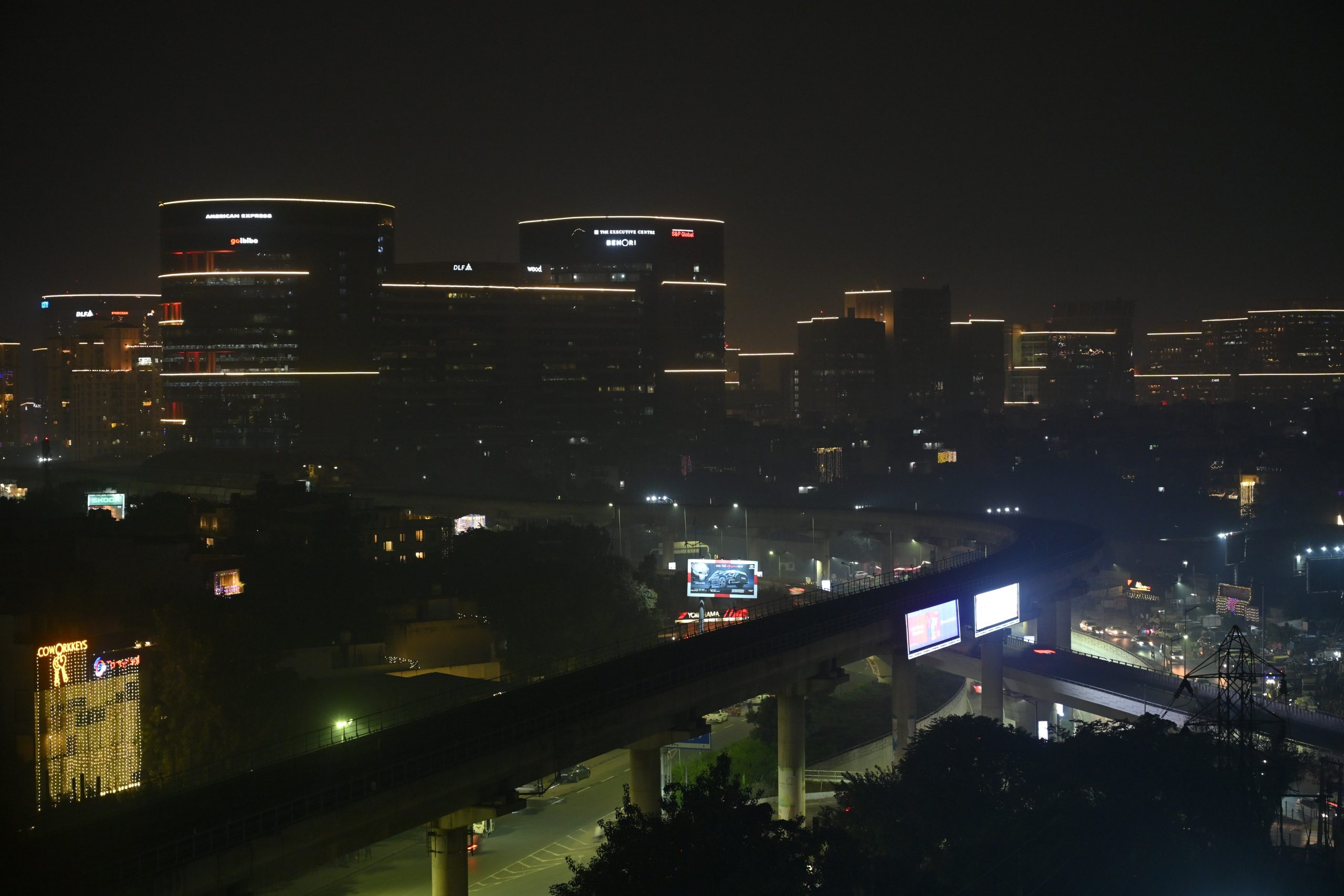
People can turn off a television or cover an LED display. They have much less control over illuminated streets, commercial signage, apartment design, shift work or urban light spilling through bedroom windows.
The accompanying editorial points toward measures such as shielded street lighting, warmer-spectrum bulbs and dimming systems as potential population-level responses.
But policy is ahead of the evidence if those measures are framed as proven cardiovascular interventions.
What is needed next is stronger prospective and interventional research that measures light exposure over longer periods and tests whether reducing it actually improves sleep physiology, blood pressure, cardiac function or eventually cardiovascular outcomes.
The current study also has important limits. UK Biobank participants are generally healthier than the wider population, about 97.6% of the imaging cohort was White, light exposure was measured for only one week, and shift workers were excluded from the main analysis. Those limitations make it difficult to assume that the same associations apply equally across more diverse populations or people with irregular circadian schedules.
Yet the study poses a valuable challenge to cardiovascular prevention.
Medicine is very comfortable telling patients what to change about themselves.
It is less comfortable asking what needs to change about the environment around them.
If nighttime light ultimately proves to be part of cardiovascular risk, precision prevention may need to become more precise about where people live and sleep, not only what their laboratory results say.
