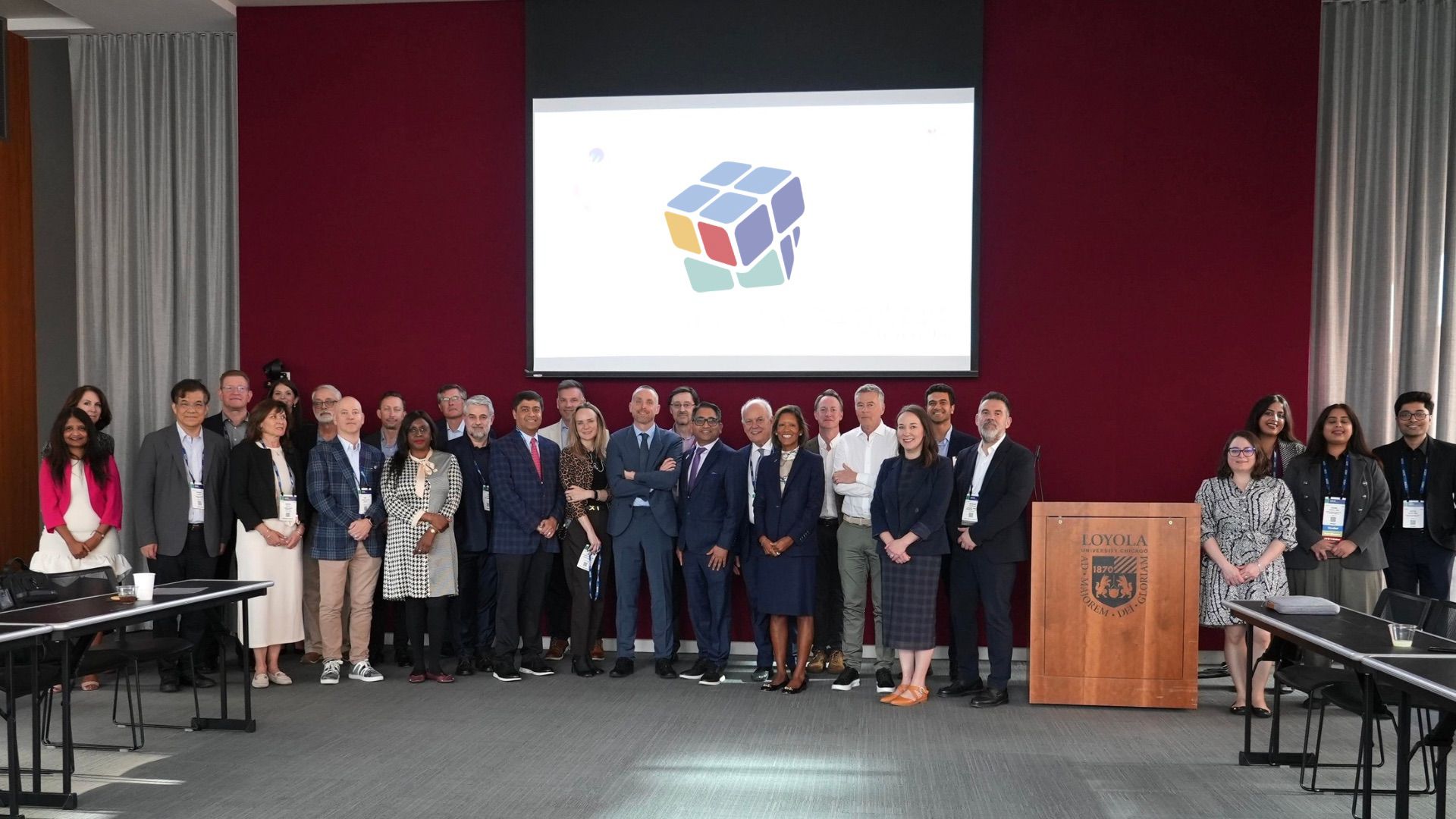
The launch brought together leading voices from oncology, personalised medicine, regulation, policy, patient advocacy, and healthcare systems. The discussion was shaped by key contributions from Vivek Subbiah, Manmeet Singh Ahluwalia, Prof. Dr. Wenbin Li, Professor Paolo Marchetti, Denis Horgan, and the broader IAPM Board.
The event confirmed IAPM’s role as a trusted partner, convening platform, and reference point for the community working to bring personalised medicine into healthcare systems.
ASCO shows the science. IAPM focuses on delivery.
The 2026 ASCO Annual Meeting demonstrated how rapidly cancer care is changing. Precision oncology is moving earlier in the disease pathway. Molecular diagnostics are becoming central to treatment decisions. Smarter trials are identifying which patients need more treatment and which patients may safely avoid unnecessary harm.
In lung cancer, data in RET fusion-positive early-stage NSCLC showed why molecular profiling must happen early, not after treatment options have narrowed. In breast cancer, evidence supporting the omission of axillary lymph node dissection in selected patients showed that progress is not only about treating more aggressively, but about treating more intelligently and reducing unnecessary morbidity. In pancreatic cancer, new RAS-targeting approaches demonstrated that even some of oncology’s hardest frontiers are beginning to shift.
Together, these examples capture the promise of personalised oncology: better targeting, better timing, better decisions, and better outcomes.
But they also expose the access challenge.
A breakthrough therapy is of limited value if the biomarker test is unavailable, delayed, unfunded, or inconsistently ordered. De-escalation cannot become standard practice if pathways are not updated. A clinical trial cannot improve outcomes if patients are never referred. A targeted therapy cannot transform survival if healthcare systems are not ready to identify eligible patients and deliver treatment in time.
This is the implementation gap that IAPM is committed to addressing.
The barriers are practical — and political
The ASCO launch and the bilateral meetings around it focused on the real-world barriers that continue to limit access to personalised cancer care.
These include unequal access to biomarker testing, delays in molecular diagnostics, fragmented reimbursement, lack of harmonised protocols, limited clinical trial access, workforce and pathology capacity constraints, data interoperability gaps, and policy frameworks that have not kept pace with the science.
These are not abstract problems. They determine whether a patient receives the right test before treatment begins. They determine whether a clinician has the data needed to act. They determine whether innovation reaches routine care or remains trapped in conference presentations, journal articles, regulatory approvals, and isolated centres of excellence.
The science is moving fast. Systems must now catch up.
Where science meets policy
The IAPM Oncology Pillar has been launched to serve as the place where science meets policy in the personalised medicine era.
Its purpose is to connect the communities that must work together to close the gap between discovery and delivery: clinicians, researchers, regulators, payers, policymakers, patients, industry, and health system leaders.
Across a wide number of bilateral meetings at ASCO, IAPM focused on practical cooperation to support access to biomarker testing, improve access to clinical trials, strengthen diagnostic capacity, and help countries embed personalised medicine into routine oncology pathways.
The message was clear: implementation cannot be left until after innovation arrives. Health systems must prepare earlier, align faster, and work across silos.
That means making biomarker testing available, reimbursed, quality-assured, and embedded into cancer pathways. It means improving trial referral and participation. It means modernising HTA and reimbursement approaches for diagnostics, targeted therapies, combination strategies, and real-world evidence. It means supporting countries and regions with the tools needed to make personalised medicine part of standard care.
From Geneva to ASCO and towards New York
The Oncology Pillar launch at ASCO builds on IAPM’s wider engagement, including its launch activities in Geneva during WHA week. From Geneva to Chicago, the same message has emerged: personalised medicine is no longer a future ambition. It is already reshaping cancer care.
Looking ahead to IAPM’s UN-focused engagement in New York on September 23/24, the task is to turn scientific momentum into political commitment.
“The science is delivering, but patients cannot benefit from innovation unless healthcare systems are ready to deliver it,” said Denis Horgan. “IAPM is here to help close that implementation gap by connecting science, policy, regulation, and access in a way that turns personalised medicine from promise into practice.”
The launch of the IAPM Oncology Pillar at ASCO was not just a successful event. It was a statement of intent.
Personalised medicine can transform cancer care. But only if patients can access the tests, trials, and treatments that make it possible.
IAPM is ready to support that transformation.
