
IPM Take
Alzheimer’s trials still ask too much from patients and too little from their data.
A person travels to clinic, waits, completes a formal assessment and goes home. Weeks or months later, the process repeats. Then the system calls those snapshots a measure of decline.
A new UK feasibility study does not prove that home EEG will transform Alzheimer’s trials. It proves something more basic: many people with mild dementia can generate frequent, usable data from home. The real policy question is why trial infrastructure has been so slow to build around that reality.
Executive Summary
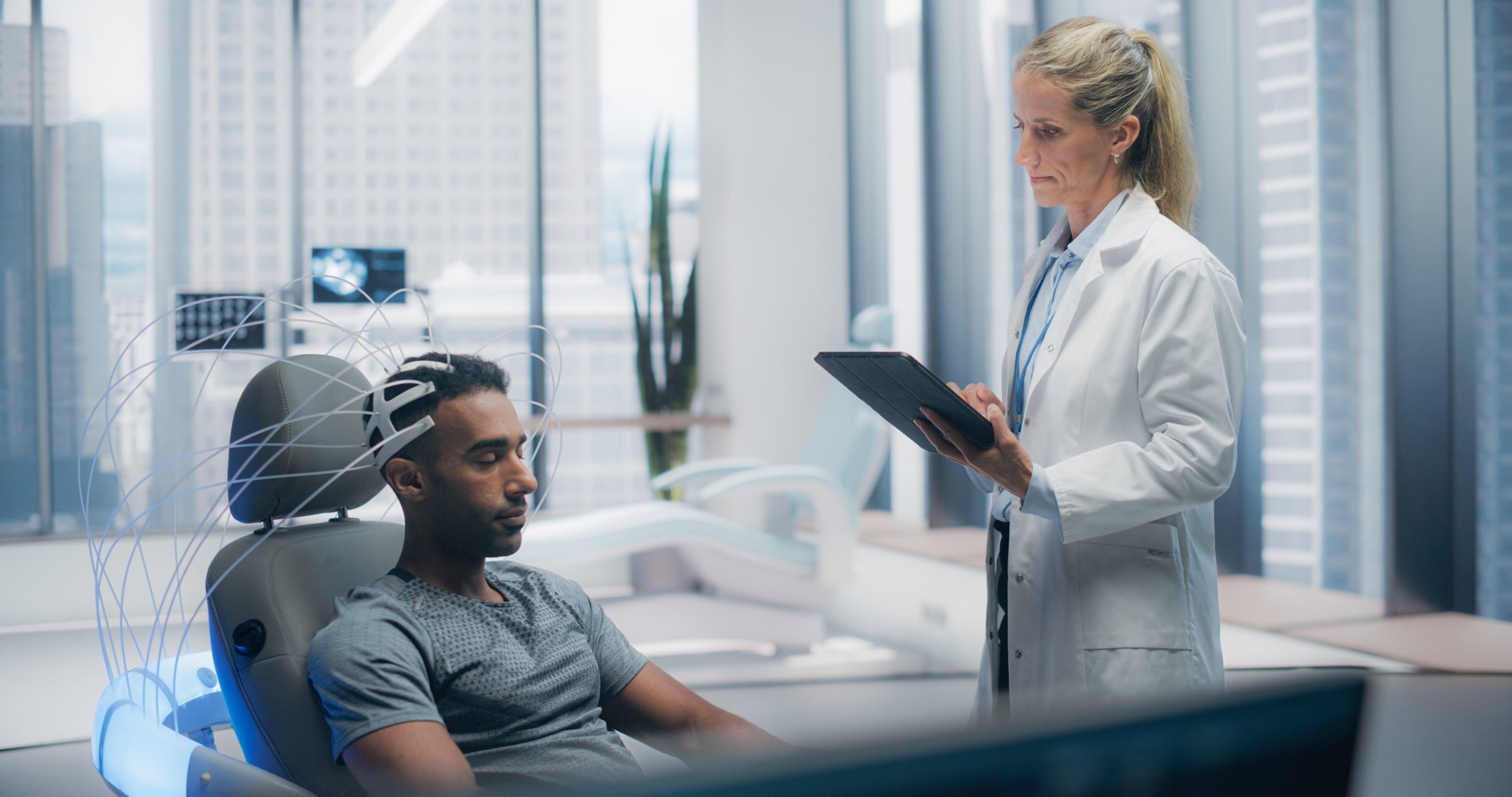
A peer-reviewed UK study evaluated the feasibility of using the Cumulus NeuLogiq platform at home over 52 weeks in people with mild Alzheimer’s disease dementia.
The unblinded, non-randomised observational study enrolled 119 participants across seven UK sites: 59 people with mild Alzheimer’s dementia and 60 age-matched controls. The platform combined a wireless dry-sensor EEG headset, tablet-based cognitive tasks, sleep monitoring and other digital assessments.
Participants with dementia achieved 77.0% adherence to the requested protocol across the year. From study stages two to four, the dementia group completed 2,399 of 2,407 sessions they initiated. However, 16 people with Alzheimer’s-type dementia withdrew from remote monitoring during the study period.
The study shows that long-term home monitoring is feasible for selected people with mild Alzheimer’s dementia. It does not show that the platform improves diagnosis, predicts disease progression, shortens trials or detects treatment benefit more accurately than current endpoints.
Cumulus Neuroscience sponsored the study and was involved in its design and conduct. Several authors were company employees or affiliated with companies that fund Cumulus through a pre-clinical consortium.
Why it matters
- Patients / advocates: Home monitoring could reduce clinic burden, but it must be designed around real support needs rather than assuming every person has reliable technology, digital confidence and someone to help.
- Researchers / academia: Feasibility is an important first step. The next studies need to demonstrate clinical validity, responsiveness to change and a clear relationship with outcomes patients value.
- Data / AI leaders: More frequent data collection is only progress if it improves trial decisions without creating a new digital exclusion problem.
Alzheimer’s trials have spent years looking for more sensitive ways to measure change.
Yet the evidence architecture often remains strangely old-fashioned. Infrequent clinic visits. Long assessments. High travel burden. Results shaped by the day a patient happened to attend, the clinician who administered the test and the narrow window in which the disease was observed.
The Cumulus study challenges one assumption behind that system: that people with mild dementia cannot reliably participate in demanding home-based measurement.
They can, at least some of them can.
Across a year-long protocol, people with mild Alzheimer’s dementia used an EEG headset and tablet-based cognitive tasks at home with 77% overall adherence. Once participants began a session, completion was exceptionally high. That is not a cure, a diagnostic breakthrough or proof that digital biomarkers outperform existing trial endpoints. But it is a serious operational signal.
It also comes with a warning.
The study population was not a random cross-section of everyone living with dementia. Participants needed home Wi-Fi, English fluency, capacity to consent and access to a study partner where necessary. People who withdrew were more likely to cite personal circumstances, technology burden or feeling overwhelmed by the demands of remote monitoring.
That is the implementation issue.
Digital trials cannot become a new form of selection bias, where the patients easiest to monitor become the patients whose disease defines the evidence base. A decentralised approach is only patient-centred if it is accessible, supported and designed for people who are not already digitally confident.
The study has opened the door. It has not yet shown what lies beyond it.
The next question is whether home-based data can make trials more sensitive to meaningful change, more inclusive of real patients and less dependent on evidence gathered too little, too late.
